Operating a House in Multiple Occupation (HMO) in London involves adhering to strict HMO licensing safety requirements designed to safeguard tenants and maintain high standards. With each London borough enforcing detailed regulations, landlords must understand the legal framework, inspection processes, certification requirements, and council mandates. This guide offers a thorough overview, including service steps and pricing insights to help landlords navigate compliance confidently and efficiently.
Legal Framework Governing HMOs in London
HMOs are properties rented out by three or more tenants forming more than one household who share amenities. The Housing Act 2004 sets primary licensing regimes, reinforced by the Housing Health and Safety Rating System (HHSRS) and the Regulatory Reform (Fire Safety) Order 2005.
Key legal requirements include:
- Mandatory HMO Licensing: Applies to HMOs housing five or more persons across two or more households and usually involving properties with three or more storeys. Many boroughs also operate additional or selective licensing schemes covering smaller HMOs.
- Fire Safety Regulations: Fire risk assessments are compulsory, focusing on detection/alarm systems, escape routes, fire doors, and emergency lighting.
- Gas Safety: Annual Gas Safety Certificates (CP12) by Gas Safe registered engineers are mandatory.
- Electrical Safety: Electrical installations must be inspected every five years via an Electrical Installation Condition Report (EICR).
- Energy Efficiency: An Energy Performance Certificate (EPC) with at least an E rating is required.
- Smoke and Carbon Monoxide Alarms: Must be installed and maintained appropriately per floor and room specifications.
- Adequate Facilities: Kitchen, bathroom, and washing facilities to meet statutory minima for the number of occupants.
Non-compliance can result in fines, licensing refusal or revocation, and enforcement actions.
Fire Risk Assessment in HMO Licensing
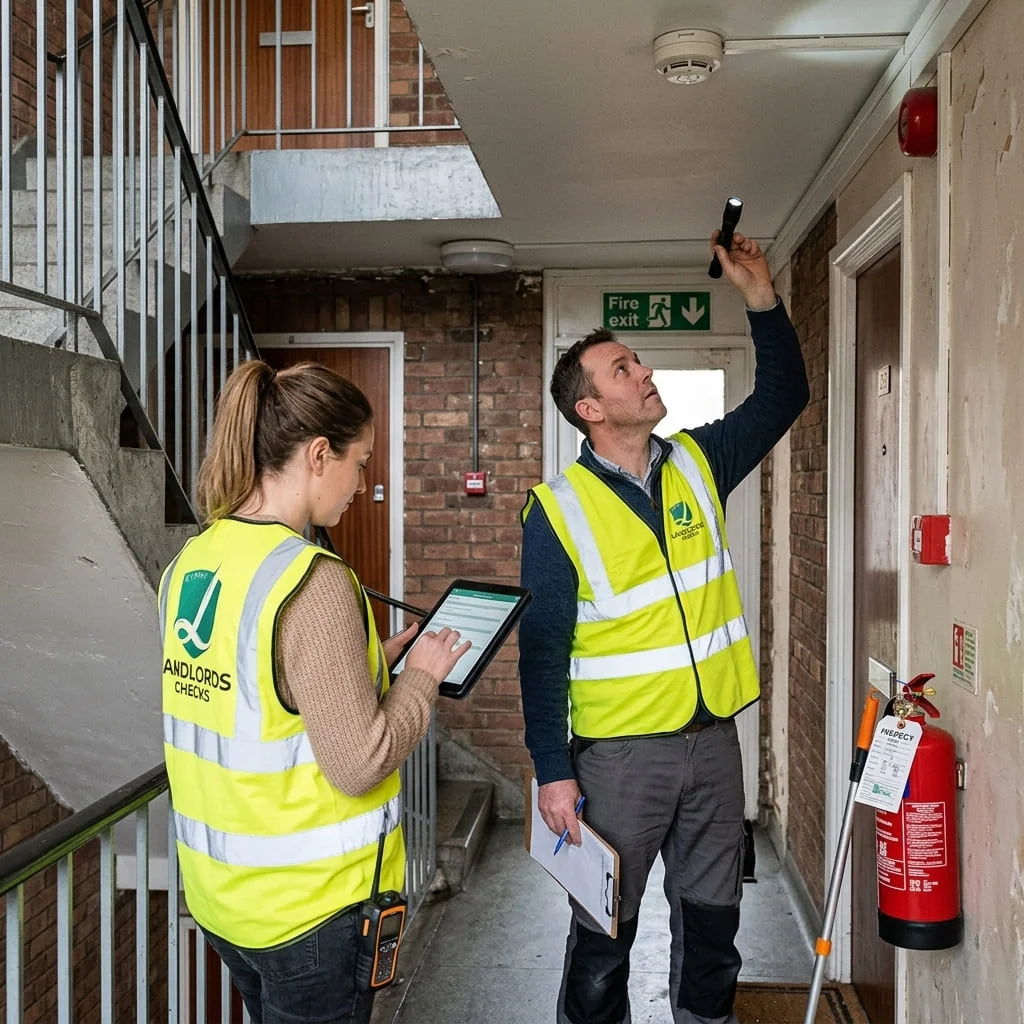
One of the most critical components for HMO licensing is the fire risk assessment (FRA). It involves:
- Identifying fire hazards in the property such as cooking areas, electrical equipment, and smoking risks.
- Evaluating the risk these hazards pose to tenants.
- Inspecting escape routes, emergency lighting, fire alarms, extinguishers, and signage.
- Recommending measures to mitigate fire risks and maintain safe living conditions.
- Reviewing and updating the assessment regularly or after significant changes.
Landlords must ensure FRAs are conducted by qualified professionals, such as those holding a Fire Technician (TIFSM) qualification.
The HMO Licensing Application and Inspection Process
- Application Submission: Landlords submit the HMO licence application along with required safety certificates and supporting documents to the local borough council.
- Council Review: The council assesses documentation and arranges a property compliance inspection.
- Compliance Inspection: An officer inspects the property for hazards, fire safety, overcrowding, facility adequacy, and adherence to licence conditions.
- Outcome Notification: Landlords receive confirmation if the property meets standards, or directives to carry out remedial works.
- Licence Granting or Refusal: Upon satisfactory conditions, the licence is granted, typically valid for up to five years.
- Ongoing Compliance: Landlords must maintain standards and renew licences accordingly.
Failure to comply during inspections may result in enforcement actions or licence denial.
Council Enforcement and Inspections in London
London councils, including Camden, Hackney, and Southwark, actively enforce HMO licensing:
- Regular compliance checks and property inspections.
- Imposition of improvement notices for breaches of licence conditions.
- Financial penalties and legal prosecution for serious non-compliance.
- Maintenance of public registries of licensed HMOs.
Landlords are advised to regularly consult their borough website for specific licensing guidance and updates.
Typical Pricing for HMO Licensing Safety Services
Costs for safety inspections and certification services vary by property size and service scope:
- Fire Risk Assessment: £80 to £300 based on property complexity.
- Gas Safety Certificate (CP12): £60 to £90 annually for standard properties.
- Electrical Installation Condition Report (EICR): £100 to £200 depending on installation size.
- HMO Licence Fees: Councils charge ranging between £500 and £1,500 depending on licence length and borough.
- Bundled services often provide cost effectiveness and administration simplification for landlords.
Landlords should budget for both safety certification and council licensing fees well in advance.
Booking Your HMO Licensing Safety Services in London
For landlords ready to comply with HMO licensing safety standards, booking your fire risk assessment through HMO licensing safety requirements London experts ensures prompt, professional inspections with accredited certification.










 Fire Risk Assessment in London: The Definitive 2026 Guide for Landlords
 Which Companies Provide Landlord Safety Certificates with Free Follow-Up Inspections?
 Which Service Offers Emergency Landlord Safety Certificate Renewals?
 Where Can I Find a Landlord Electrical Safety Certificate Provider?
 Who Provides Landlord Gas Safety Certificates with Online Booking?